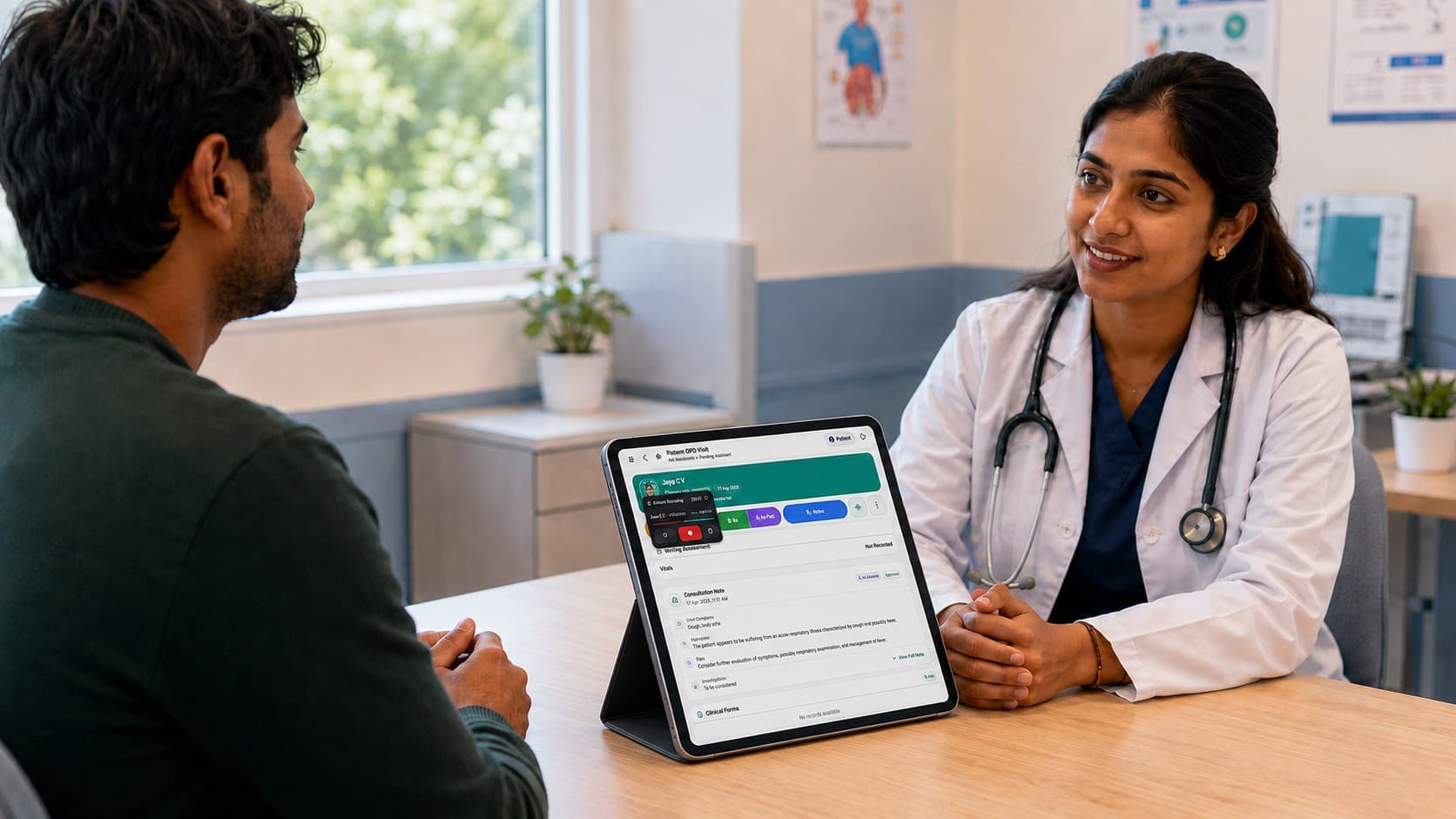
AI should reduce clinical work, not replace clinical judgment
The most valuable healthcare AI is rarely the system that makes the loudest claim. It is the one that quietly gives clinicians more time to notice, think and care.
 Responsible AI
Conversations about artificial intelligence in healthcare often drift toward a dramatic question: can AI do what a clinician does?
It is an understandable question, but it may not be the most useful one.
Healthcare professionals are already carrying a substantial burden that exists around clinical decision-making. They search through records, reconstruct patient histories, reconcile medications, prepare notes, complete forms, review reports and repeatedly enter information that may already exist elsewhere.
Reducing that burden does not require replacing clinical judgment. It requires designing technology that respects it.
The most valuable healthcare AI may not be the system that attempts to make the final decision. It may be the one that quietly prepares the information, reduces repetitive work and gives the clinician more time to notice, think and care.
A better question for clinical AI
Discussions about healthcare AI frequently begin with capability:
- What can the model detect?
- What can it predict?
- What can it generate?
- Which clinical task can it automate?
Those questions matter, but they should not be the starting point.
A more practical question is:
Key perspectiveWhat burden can we safely remove from a healthcare professional without removing the context, responsibility or human connection that good care requires?
This leads to a different kind of product design.
Instead of trying to imitate a clinician, technology can make the clinician’s work clearer and more manageable. It can prepare information, organise documentation, identify possible gaps and make relevant evidence easier to find.
Healthcare decisions are rarely based on one perfectly complete dataset. They are shaped by evolving symptoms, incomplete histories, local protocols, available resources, previous treatment, family circumstances and the patient’s own priorities.
Useful AI must fit inside that reality rather than pretending it does not exist.
Reduce the work around the decision
A large part of clinical workload is not the final decision itself. It is the work required to reach, document and communicate that decision.
Information may be distributed across consultation notes, prescriptions, laboratory reports, scanned documents, nursing records and discharge forms. Clinicians may spend valuable time finding details that the system already contains but does not present effectively.
AI can help with this surrounding workload.
It can draft a structured note from a consultation, summarise a lengthy patient history, identify incomplete fields or bring relevant reports into view. The clinician can then verify, correct and approve the result.
In this role, AI becomes a preparation layer rather than an invisible authority.
Practical uses can include:
- Drafting clinical documentation while preserving the original source material
- Summarising records with links back to the supporting evidence
- Highlighting possible gaps, conflicts or overdue actions for review
- Organising information from multiple stages of the patient journey
- Reducing duplicate entry across connected clinical workflows
- Preparing discharge documentation for clinician verification
- Bringing relevant previous results into the current clinical context
These are not minor improvements. When repeated across many consultations, admissions and discharges, small reductions in administrative effort can return meaningful time to healthcare teams.
Preparation is different from decision-making
The difference between assisting and deciding should remain visible in the product.
An AI-generated summary can help a clinician understand a long record more quickly. It should not silently decide which information is clinically important.
A generated discharge draft can organise diagnoses, treatment details and follow-up instructions. It should not be finalised without professional review.
A system can highlight a possible medication conflict. It should present the relevant evidence and allow the clinician to interpret it within the patient’s full context.
This boundary is essential because an output can appear confident even when the underlying information is incomplete, outdated or misunderstood.
Good clinical AI should make it clear when content has been generated, what information was used and what still requires confirmation.
The clinician should never have to guess whether a statement came from the medical record, from the patient, from another professional or from an AI-generated interpretation.
Evidence should remain visible
An answer without provenance can create false confidence.
If an AI-generated summary mentions an abnormal laboratory result, the clinician should be able to return to the original report. If it identifies a medication concern, the active order and administration history should remain accessible. If it summarises a previous diagnosis, the supporting consultation or discharge record should be available for review.
The path back to evidence should be short and obvious.
Responsible healthcare AI should distinguish between:
- Information recorded directly in the patient’s chart
- Information reported by the patient
- Observations documented by healthcare professionals
- AI-generated summaries
- AI-generated suggestions or possible interpretations
- Information that remains uncertain or incomplete
This becomes particularly important when records are lengthy, fragmented or multilingual. Clinical meaning can depend on subtle language, timing and context. A summary that removes those details may be easier to read but less safe to rely upon.
Good design does not merely provide an answer. It helps the professional understand where that answer came from.
Human oversight must be meaningful
Adding a “Review” or “Approve” button does not automatically create meaningful human oversight.
If the interface encourages hurried approval, hides the original evidence or makes corrections difficult, the professional may technically remain involved without having a realistic opportunity to evaluate the output.
Meaningful oversight requires enough context and control to make review genuine.
The clinician should be able to:
- Edit generated content before it enters the clinical record
- See important source information alongside the draft
- Identify which information was generated or transformed by AI
- Review uncertainty, missing data and conflicting information
- Reject inappropriate suggestions without disrupting the workflow
- Deliberately confirm high-impact actions
- Understand when and how the generated content will be saved
The system should also preserve an appropriate audit trail.
An organisation may need to know what the system generated, what the user changed, who approved the final content and when it became part of the clinical record.
Accountability should not disappear simply because one stage of the workflow uses AI.
The interface influences the quality of review
Responsible AI is not only a question of model accuracy. Interface design also affects safety.
A generated note may contain mostly correct information with one important error. If the page presents it as a polished final document, the user may be encouraged to accept it too quickly.
A better interface treats the output as a draft.
It can highlight missing information, distinguish generated content from confirmed data and place important warnings where they are difficult to overlook. It can also make the safest action the easiest action—for example, preserving existing values unless the clinician deliberately chooses to replace them.
The language used by the application matters as well.
Terms such as “AI draft,” “suggested information” and “requires review” communicate a different level of certainty from phrases such as “completed diagnosis” or “final recommendation.”
Design should reinforce the appropriate role of the technology.
Connected information makes AI more useful
AI cannot compensate for a fundamentally fragmented patient journey.
If registration, consultation, admission, medication, billing and discharge operate as disconnected applications, even a capable AI system may receive only a partial view of the patient’s story.
Connected workflows create a stronger foundation.
When authorised information can follow the patient appropriately, AI can help prepare context without forcing users to search across multiple systems. A clinician reviewing a discharge draft can see the relevant admission details, treatment history, medications, reports and follow-up requirements in one workflow.
The value comes from combining thoughtful automation with connected information.
The goal should not be to generate more content. It should be to help the right professional understand and act on the right information at the right time.
Measure time returned to care
The success of healthcare AI should not be measured only by the number of notes generated, documents processed or suggestions displayed.
Those numbers describe activity. They do not necessarily describe value.
More meaningful measures include:
- Time saved during documentation
- Reduction in incomplete records
- Fewer repeated searches across applications
- Faster preparation of discharge documentation
- Improved turnaround for administrative workflows
- Fewer instances of duplicated data entry
- The amount of correction required before approval
- Whether clinicians feel more or less in control
- Whether patients experience a more attentive consultation
Quality also matters.
If AI produces a draft quickly but requires extensive correction, the apparent efficiency may disappear. If it saves time but makes the evidence harder to verify, it may introduce a different kind of risk.
The strongest systems may feel almost unremarkable. They reduce clicks, prepare useful context and step aside when judgment is required.
Their value appears in a calmer workflow and more attention available for the patient.
Start with a controlled clinical workflow
Healthcare organisations do not need to introduce AI everywhere at once.
A focused workflow is often the better place to begin.
Choose an area where the administrative burden is clear and where professional review already exists. Clinical note drafting, document summarisation and discharge preparation may be suitable examples.
Then evaluate the workflow carefully:
- Identify the burden being reduced.
- Define what the AI may prepare or suggest.
- Define what must remain under professional control.
- Preserve access to the supporting evidence.
- Require appropriate review before saving or acting.
- Record meaningful corrections and approvals.
- Measure time saved and the quality of the final result.
- Gather feedback from the people using it in daily care.
This approach creates evidence for responsible expansion. It also helps organisations distinguish between a feature that looks impressive during a demonstration and one that genuinely improves clinical work.
Better-supported medicine
Healthcare professionals do not need technology that competes with their expertise. They need systems that help them apply that expertise with less friction.
AI can prepare, organise and surface information. It can reduce repetitive documentation, bring relevant evidence into view and help clinical teams notice what may require attention.
But interpretation still depends on context. Communication still depends on trust. Accountability still belongs to people and organisations. Final clinical decisions still require qualified professionals.
That is not a limitation of responsible AI.
It is the principle that makes responsible clinical AI worth using.
The future of healthcare technology should not be defined by how much judgment it can remove from the clinician. It should be defined by how much unnecessary work it can remove from the clinician’s day—while leaving them with more time, better information and greater capacity to care.