
Why the patient journey should not be split across applications
A patient experiences one journey. Hospital software should not turn it into a collection of disconnected administrative events.
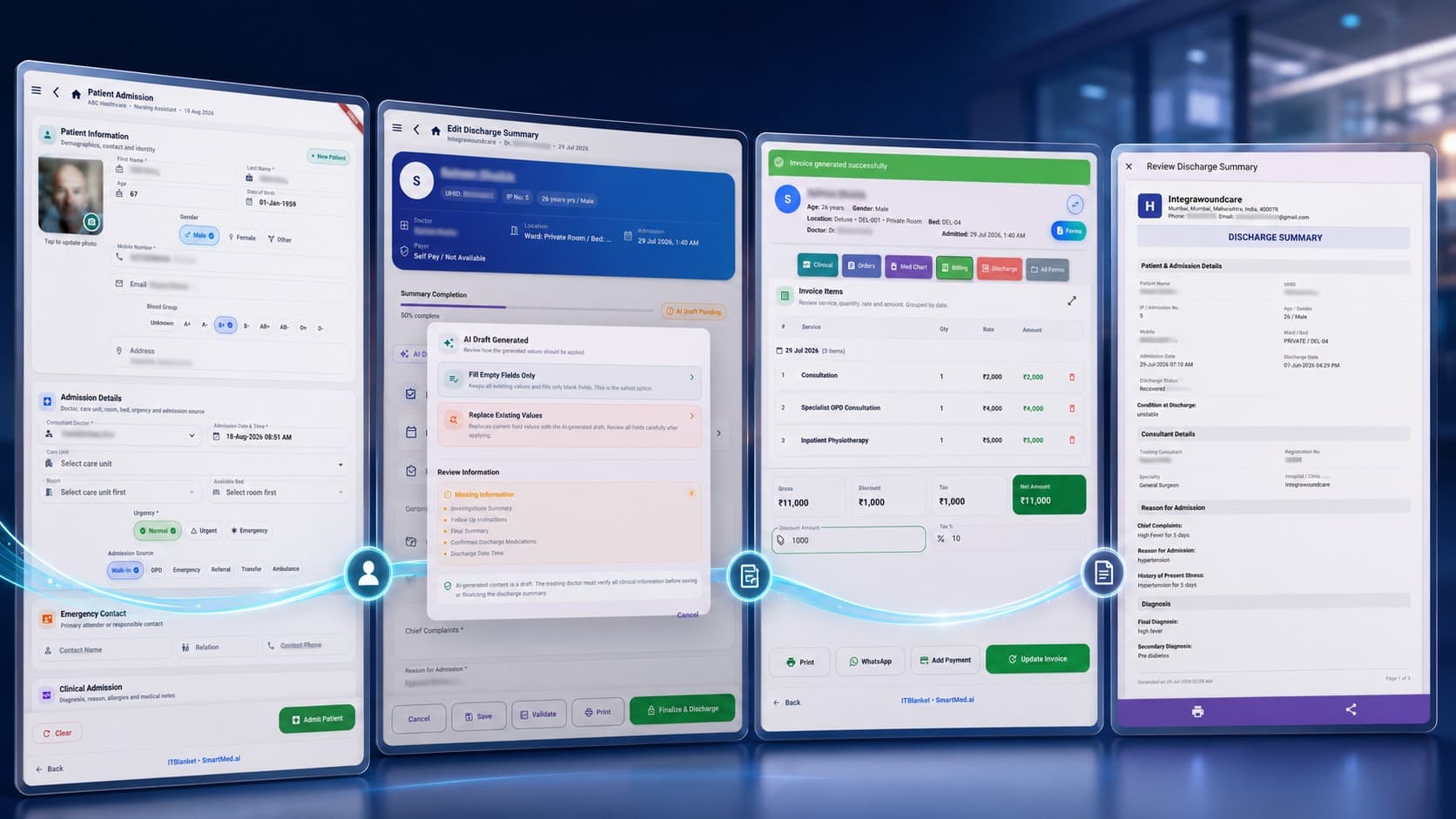 Healthcare Operations
A patient arrives at a hospital with one concern and one personal story.
From the patient’s perspective, registration, consultation, investigation, admission, treatment, billing and discharge are not separate products. They are stages of one experience delivered by one healthcare organisation.
Hospital software often sees something different.
Registration may exist in one application, clinical notes in another, laboratory information in a separate portal and billing in yet another system. Each application may perform its own task successfully while the patient’s complete journey remains fragmented.
The consequences are familiar: patients repeat the same information, staff enter the same details multiple times, departments call one another for updates and discharge teams reconstruct a story that the organisation has already collected in pieces.
A connected patient journey does not require every employee to see everything. It requires relevant information to retain its meaning and remain available to the next authorised person responsible for the patient’s care.
The patient sees one organisation
Patients rarely think in terms of registration software, consultation modules, laboratory portals, admission systems or billing applications.
They see one clinic or hospital.
They expect the organisation to remember the information they have already provided. They expect the clinician to know why they arrived, the laboratory to receive the correct order and the billing team to recognise the services that were delivered.
When that continuity breaks, the patient experiences the fragmentation directly.
They may be asked to provide the same demographic information at multiple counters. They may have to explain a clinical history again because it is not visible to the next team. A result available in one department may remain unknown in another. At discharge, instructions may be delayed while staff search for missing information.
Internally, each department may appear to have completed its work. From the patient’s perspective, however, the organisation has failed to act as one coordinated service.
Healthcare technology should help the organisation preserve that continuity.
Fragmentation creates invisible work
Disconnected applications do not eliminate work. They move it onto healthcare staff.
Someone must copy the patient identifier from one screen to another. Someone must reconcile conflicting demographic fields. Someone must call another department to ask whether an investigation has been completed. Someone must maintain a spreadsheet because no available screen can answer a simple operational question.
This work is easy to overlook because it is distributed across many people and many small actions.
Common signs of fragmentation include:
- Repeated demographic and clinical data entry
- Duplicate patient records
- Inconsistent identifiers across departments
- Delayed visibility of orders, results and care status
- Manual calls or messages for routine status updates
- Parallel spreadsheets maintained outside the primary system
- Services completed clinically but missing from billing
- Manual reconciliation before discharge
- Documents downloaded from one system and uploaded into another
- Staff relying on memory to complete workflow transitions
Each manual handoff introduces risk.
A mistyped identifier can attach information to the wrong context. An order copied incorrectly may cause delay or duplication. A status that is not updated may leave another team waiting unnecessarily. A completed service that never reaches billing becomes lost revenue.
The cost is not only administrative. Fragmentation can affect turnaround time, staff workload, financial accuracy and the patient’s confidence in the organisation.
A shared identity is the beginning
A connected journey starts with a reliable patient identity.
Every consultation, admission, order, document, payment and discharge event should refer to the correct patient and the correct encounter. Without that foundation, even sophisticated integrations can move information into the wrong context.
The patient identifier should remain consistent as the patient moves through the organisation. The encounter should also be clear: is the information related to today’s outpatient consultation, an active admission or a previous episode of care?
This distinction becomes especially important when the same patient has multiple appointments, recurring treatment or more than one admission.
A useful connected workflow should make it possible to understand:
- Who the patient is
- Why the current encounter exists
- Which healthcare professionals are involved
- Which orders belong to this encounter
- Which services have been completed
- Which results and documents are available
- What remains pending
- What should happen next
Connection begins when every stage can reliably contribute to the same patient story.
Connected does not mean crowded
A connected workspace should not display every available detail to every user.
Reception, nursing, clinicians, laboratory teams, pharmacy staff, finance teams and administrators have different responsibilities. Showing all information on every screen would create noise, increase cognitive burden and potentially expose information unnecessarily.
The goal is shared patient context with role-appropriate views and actions.
A receptionist may need identity, appointment and payment information. A nurse may need care tasks, observations and pending instructions. A clinician may need history, results, medications and clinical documentation. A billing user may need completed services, payer information and outstanding amounts.
Each screen can remain focused while drawing from the same reliable patient journey.
A connected system should therefore answer two questions carefully:
- What information does this person need to perform the current responsibility?
- What information should remain restricted, summarised or hidden?
Good connection reduces noise. It does not create an enormous screen containing every field collected by the organisation.
Design around transitions
Many operational failures do not occur inside a department. They occur between stages.
An admission recommendation must become an actionable admission request. A clinical order must become a visible task for the appropriate team. A completed service must become available to billing. A discharge decision must trigger documentation, medication reconciliation, payment review and patient instructions.
These transitions are where information changes ownership.
If the transition is not designed explicitly, responsibility becomes unclear. One team may believe the next team has been notified, while the next team does not know that an action is waiting.
Important transitions can include:
- Registration to consultation
- Consultation to investigation
- Outpatient care to admission
- Clinical order to task execution
- Completed service to billing
- Medication order to administration
- Investigation result to clinician review
- Discharge decision to discharge preparation
- Final bill to payment
- Discharge completion to follow-up
Each transition should make the operational state visible.
Teams should be able to understand what happened, what is currently waiting, who is responsible and what the next expected action is.
This does not require excessive alerts. It requires a reliable workflow state shared by the appropriate teams.
Clinical and financial journeys are connected
Clinical and billing workflows are often treated as separate worlds, but they describe the same care journey from different perspectives.
A consultation, investigation, procedure, medication or inpatient service has clinical meaning and may also have a financial consequence. When these systems are disconnected, completed work may not reach billing accurately or promptly.
Staff then reconstruct charges from notes, paper records, messages or departmental lists.
This can lead to:
- Missed charges
- Duplicate charges
- Delayed invoices
- Incorrect payer information
- Disputes caused by unclear service records
- Discharge delays while accounts are reconciled
A connected system does not allow billing to control clinical decisions. It ensures that appropriately recorded clinical services can flow into the financial workflow without unnecessary re-entry.
The same principle applies in reverse. Relevant payment or payer status may need to be visible to authorised operational teams without exposing financial details to everyone involved in care.
Connection should preserve responsibility while reducing duplication.
Discharge reveals the quality of the entire journey
Discharge is often where earlier fragmentation becomes most visible.
The discharge team may need to bring together admission information, diagnoses, investigations, procedures, medications, progress notes, billing status and follow-up instructions. If those elements are distributed across unrelated applications, discharge becomes a manual reconstruction exercise.
Staff search for missing details. Clinicians revisit information that should already be available. Patients wait while administrative and clinical documents are completed.
A connected workflow allows discharge preparation to begin from the information already created during care.
The system can help bring relevant details into view, identify missing sections and prepare documentation for professional review. Billing teams can see completed services. Clinicians can review the clinical summary. Patients can receive clearer instructions because the organisation is working from one coherent encounter.
A reliable discharge process is not produced only by a good discharge screen. It is the result of continuity maintained from the beginning of the patient journey.
Connection should preserve evidence and history
Information should not merely move between stages. Its meaning should remain intact.
A diagnosis should retain who recorded it and when. A result should remain connected to the original report. A medication change should preserve its clinical context. A corrected demographic field should not silently rewrite historical documents.
Connected workflows require appropriate history and traceability.
Users may need to understand:
- Where information originated
- When it was recorded
- Who entered or approved it
- Whether it has since changed
- Which encounter it belongs to
- Whether it is confirmed, pending or generated as a draft
Without this context, integration can spread uncertainty more efficiently rather than improving reliability.
The objective is not to create one constantly changing collection of fields. It is to create a coherent, traceable patient journey.
Start with continuity, not consolidation
Healthcare organisations do not necessarily need to replace every existing system at once.
A complete consolidation project can be expensive, disruptive and difficult to deliver. A more practical starting point is to identify where fragmentation creates the greatest operational burden.
Begin with:
- A reliable patient identity
- A shared encounter context
- Clear ownership at important transitions
- A small number of high-friction workflows
- Consistent status definitions
- Appropriate role-based access
- Traceable information exchange
An organisation might first connect registration with consultation, orders with billing or admission with discharge preparation.
The objective is not one enormous application or one enormous screen. It is a coherent flow in which information remains recognisable as the patient moves through care.
Progress can be measured through practical outcomes:
- Fewer repeated questions for patients
- Less duplicate entry for staff
- Faster access to results and documents
- Fewer calls for routine status updates
- Reduced reconciliation before billing
- Shorter discharge preparation time
- Fewer duplicate patient records
- Clearer ownership of pending actions
These improvements make the value of connection visible to both staff and patients.
One journey, supported by many teams
A hospital will always involve specialised roles, departments and systems. Connection does not remove those differences.
It allows them to work from a shared understanding of the patient journey.
Registration can remain focused on identity and arrival. Clinical teams can remain focused on assessment and care. Billing can remain focused on financial accuracy. Discharge can remain focused on safely completing the encounter.
What changes is the need to rebuild context at every stage.
When information follows the journey, staff spend less time searching, copying and reconciling. Teams can see what has happened and what needs to happen next. Patients experience fewer repeated questions and fewer delays caused by information that exists but cannot be found.
A patient arrives with one story.
The responsibility of healthcare technology is to help that story remain connected, understandable and available to the right people—from registration through care, billing, discharge and follow-up.