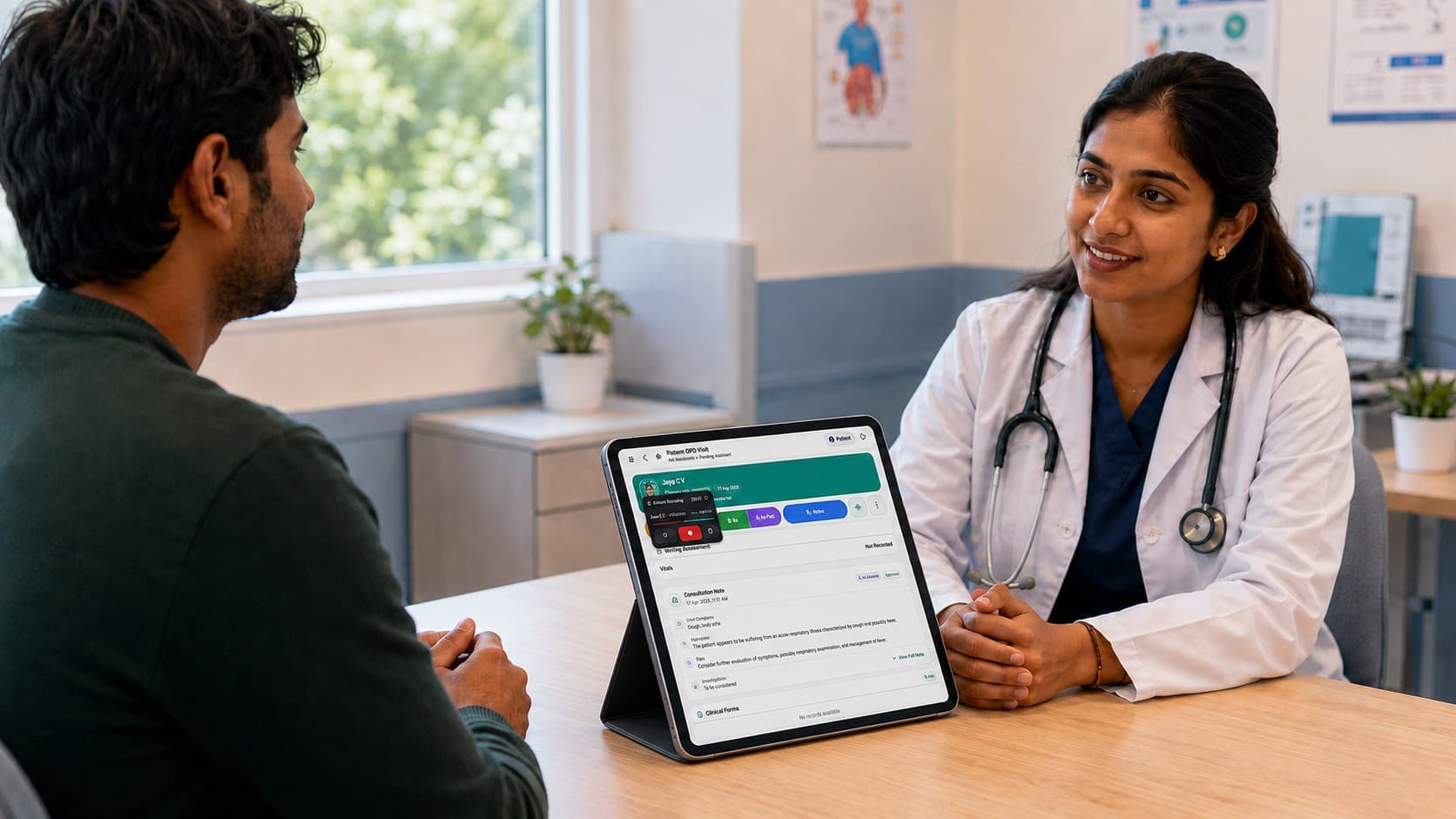
The patient journey should not end when the consultation does
Healthcare growth does not always begin with finding more patients. Often, it begins by serving existing patients more thoughtfully before, during and after every visit.
 Digital Healthcare
A patient books an appointment, arrives at the hospital, meets a clinician and returns home.
From the patient's perspective, that may feel like one continuous healthcare journey. Inside the organisation, however, it can pass through several disconnected systems, teams and conversations.
The appointment may be recorded in one place. The consultation in another. A follow-up date may be written on a prescription but never become a reminder. A recommended investigation may be clinically appropriate, yet difficult for the patient to arrange. A useful rehabilitation, preventive-care or home-care service may already exist within the hospital, but the patient may never know about it.
This is not merely a missed commercial opportunity. It is often a missed continuity opportunity.
Healthcare organisations do not always need to begin growth by spending more to attract more people. A more sustainable place to start is with the patients who already trust them: making each interaction clearer, each transition easier and each appropriate next step less likely to be forgotten.
That is the opportunity behind a connected digital patient journey.
Growth can begin with better continuity
For a hospital or clinic, growth is often discussed in terms of marketing, new enquiries and appointment volume. These matter, but they tell only part of the story.
Long-term value is also created when:
- an appointment reminder prevents a missed visit;
- a patient understands how to prepare for an investigation;
- a follow-up happens at the clinically appropriate time;
- a doctor or department becomes easier to discover;
- a patient receives useful education after consultation;
- a recommended service is simple to book;
- a care team can find the information it needs without searching through multiple systems.
Each improvement may appear small. Together, they can strengthen patient experience, staff productivity, service utilisation and retention.
The principle is simple: make the right next step easier.
One platform, one connected experience
Many healthcare organisations have already digitised individual activities. They may use one system for registration, another for billing, a messaging provider for reminders, spreadsheets for campaigns and printed material for patient education.
The difficulty is not always the absence of technology. It is the absence of connection.
SmartMed.ai brings healthcare operations, patient communication, service visibility and AI-supported knowledge access into one platform. The aim is to help clinics and hospitals move from isolated transactions toward a coordinated relationship with each patient.
That relationship can begin before the first visit.
A doctor or clinic can have a professional digital profile containing qualifications, specialties, consultation timings, location, services and an appointment action. A QR code on a reception desk, referral letter, poster or visiting card can take a patient directly to that information.
Instead of asking patients to search across websites, phone numbers and social pages, the organisation creates a clear digital front door.
Once an appointment is booked, the same connected experience can continue through reminders, queue information, consultation workflows, follow-up communication and relevant patient education.
Before the visit: make access easier
The first operational challenge in healthcare is often surprisingly basic: helping a patient find the right doctor, understand availability and complete a booking without unnecessary effort.
Digital doctor and clinic profiles can give patients a dependable source for:
- specialties and qualifications;
- consultation schedules;
- hospital or clinic location;
- available services;
- contact information;
- appointment booking;
- important pre-visit guidance.
For individual doctors and smaller clinics, this creates a professional digital presence without requiring a complex independent website. For hospitals, it gives every consultant and department a clearer way to be discovered.
This visibility can improve appointment conversion, but its value goes beyond promotion. It reduces uncertainty for patients and makes access more convenient.
During the visit: improve flow and make waiting useful
Patient experience is shaped not only by clinical quality, but also by what happens around the consultation.
Digital token and queue displays can show the current token, the next token and the appropriate consultation room. This reduces repeated questions at reception, helps staff coordinate patient flow and creates a calmer, more professional waiting environment.
Waiting time can also become useful time.
Instead of a silent television or a wall of static posters, a waiting-room display can share:
- doctor and department introductions;
- preventive-health guidance;
- patient education;
- information about new or underused services;
- available health packages;
- hospital announcements and campaigns.
The distinction matters. A responsible waiting-room channel should not pressure people into unnecessary care. It should help them understand services that may be relevant and encourage informed conversations with qualified professionals.
When handled well, the waiting room becomes both an education channel and a service-discovery channel.
After the visit: do not leave continuity to memory
The period after consultation is where many patient journeys quietly break.
A patient may intend to return, book an investigation or follow the clinician's advice. Then everyday life intervenes. Instructions are misplaced. Dates are forgotten. The patient waits for symptoms to worsen before reconnecting.
Thoughtful communication can reduce this gap.
Using approved SMS, WhatsApp or email workflows, a healthcare organisation can support:
- appointment and follow-up reminders;
- consultation notifications;
- pre-procedure and post-procedure instructions;
- preventive-care reminders;
- relevant health education;
- information about appropriate services or programmes;
- feedback requests and important updates.
The purpose is not to send more messages. It is to send fewer, more useful messages at the right time.
Communication should be consent-aware, clinically relevant and easy to act upon. Patients should know why they are receiving it and how to opt out where applicable. Sensitive information should be handled with appropriate privacy safeguards.
When these principles are respected, digital communication can improve attendance, follow-up compliance and long-term patient confidence.
Turn departments into connected care pathways
Hospitals often contain a wide range of valuable services that patients experience as separate departments. A connected platform can help the organisation present them as coherent care pathways.
Consider a few examples:
- Orthopaedics → Diagnostics → Physiotherapy → Rehabilitation
- Gynaecology → Maternity Care → Newborn Care → Vaccination
- Wound Care → Dressing → Advanced Therapy → Home Care
- General Medicine → Diabetes Management → Diagnostics → Preventive Care
These pathways should never be treated as automatic sales funnels. The next service must remain appropriate to the patient's condition, preferences and clinician's advice.
But when the next step is appropriate, the organisation should make it easy to understand and access.
This is where patient-centred care and sustainable growth can support one another. Better coordination reduces leakage from the care journey. Better information helps patients use services with greater confidence. Better follow-up strengthens relationships instead of repeatedly restarting them.
Build relationships, not one-time transactions
Acquiring a new patient is important. Retaining trust after the first visit is more valuable.
A connected system can help a clinic or hospital move from a one-time consultation model toward a longer-term relationship model:
Discovery → Appointment → Consultation → Follow-up → Ongoing care
For some patients, ongoing care may include preventive screening, chronic-disease programmes, rehabilitation, maternity support, senior-care services, teleconsultation or home healthcare. For others, no additional service may be necessary.
The platform's role is not to manufacture demand. It is to ensure that genuine needs are not lost because information, communication or access was fragmented.
This same foundation can support thoughtfully designed memberships and packages, including family health plans, preventive-care programmes, maternity packages and chronic-care programmes. When the offering is transparent and clinically meaningful, it can give patients easier access to planned care while giving the organisation more predictable engagement.
Make institutional knowledge easier to use
Patient-facing growth is only one part of the opportunity. Hospitals also carry a large amount of internal knowledge:
- standard operating procedures;
- department protocols;
- service information;
- policies and frequently asked questions;
- training and onboarding material;
- approved patient-education content.
Much of this knowledge is stored across documents, folders and individual experience. Staff may spend valuable time searching for an answer or asking the same administrative question repeatedly.
SmartMed.ai can provide an AI-supported knowledge layer over approved organisational content. Team members can ask questions in natural language and retrieve relevant information more quickly.
The important word is approved.
AI should make trusted information easier to find; it should not invent policy, replace clinical judgment or turn an outdated document into an authoritative answer. Source governance, access controls, human review and regular content updates remain essential.
Used with those safeguards, institutional knowledge becomes a practical digital asset—available for daily work, staff training and more consistent service delivery.
Use data to decide where attention is needed
Digital workflows can also give management a clearer view of what is happening across the organisation.
Instead of relying only on intuition, teams can begin asking:
- Which departments are growing?
- Where are appointments being missed?
- Which follow-ups remain incomplete?
- Which services are difficult for patients to discover?
- Which campaigns lead to genuine enquiries or bookings?
- Where does the patient journey most often stop?
These insights can guide staffing, communication, service design and patient-engagement priorities.
The goal is not simply to produce more dashboards. It is to help teams notice where a small operational improvement could make a meaningful difference.
Responsible growth is the only growth worth building
Healthcare communication is not ordinary retail marketing.
Patients may be worried, unwell or unfamiliar with their options. Their data is sensitive. Recommendations can affect both health and household finances. That demands a higher standard.
A responsible digital growth programme should be built around:
- patient consent and communication preferences;
- privacy and secure handling of health information;
- clinically relevant segmentation;
- clear, non-misleading language;
- appropriate human review;
- compliance with healthcare advertising, messaging and professional-conduct requirements;
- measurement that values patient outcomes and experience, not only conversions.
Technology can help an organisation communicate more efficiently. Trust determines whether that communication creates a lasting relationship.
Start with one patient journey
Digital transformation can sound like a large, multi-year programme. It does not have to begin that way.
Choose one common patient journey in your clinic or hospital. It might be an orthopaedic consultation, a maternity pathway, a preventive-health package or post-discharge follow-up.
Then map five moments:
- How does the patient discover and book the service?
- What information do they need before arriving?
- What friction do they experience during the visit?
- What should happen after the consultation?
- How will the organisation know whether continuity improved?
Connect those moments with a clear digital profile, simpler booking, coordinated patient flow, useful communication and measurable follow-up.
The result is not merely a more modern-looking hospital. It is a healthcare organisation that is easier to access, easier to understand and easier to remain connected with.
That is where sustainable growth begins.
See the connected journey in practice
SmartMed.ai is designed for doctors, clinics, hospitals, diagnostic centres and healthcare organisations that want to bring operations, communication, patient engagement, service visibility and AI-supported knowledge into one connected platform.
A short demonstration can begin with your existing workflow—not a generic feature tour. Choose one patient journey, and see how it could become simpler for staff, clearer for patients and more valuable for the organisation.
Digitize. Communicate. Promote responsibly. Engage. Retain. Grow.